

Industrial Plastic Parts Injection Moulding Solutions
Industrial plastic components are used across a wide range of manufacturing sectors, from fluid handling and mechanical equipment to electrical systems, industrial storage, and machinery assemblies.
Unlike simple consumer products, industrial components often have specific functional requirements. They may need to withstand mechanical loads, pressure, repeated movement, temperature variations, chemical exposure, or long-term operating conditions.
ARLEX provides injection moulding machine solutions for industrial plastic parts, with machine configurations evaluated according to component geometry, resin characteristics, mould dimensions, injection requirements, and production conditions.
1. Industrial Plastic Parts Applications
Pipe Fittings and Fluid Handling Components
Industrial plastic fittings are used in water distribution, irrigation, chemical handling, plumbing, and fluid management systems.
Typical products include:
- Pipe elbows and tees
- Couplings and connectors
- Flanges and adapters
- Plastic valves and valve bodies
- Irrigation fittings
- Water management components
Production requirements:
- Sufficient injection capacity for thick-wall components
- Stable holding pressure to compensate for material shrinkage
- Suitable mould design for internal channels and complex structures
- Hydraulic core-pull functions where required
- Appropriate material compatibility
For large or thick-wall fittings, the injection unit must be matched to the complete shot size and required filling conditions. Clamping force should be evaluated according to the projected area and cavity pressure rather than part weight alone.

Precision Mechanical Components
Plastic mechanical components are used in transmission systems, machinery, automation equipment, and functional assemblies.
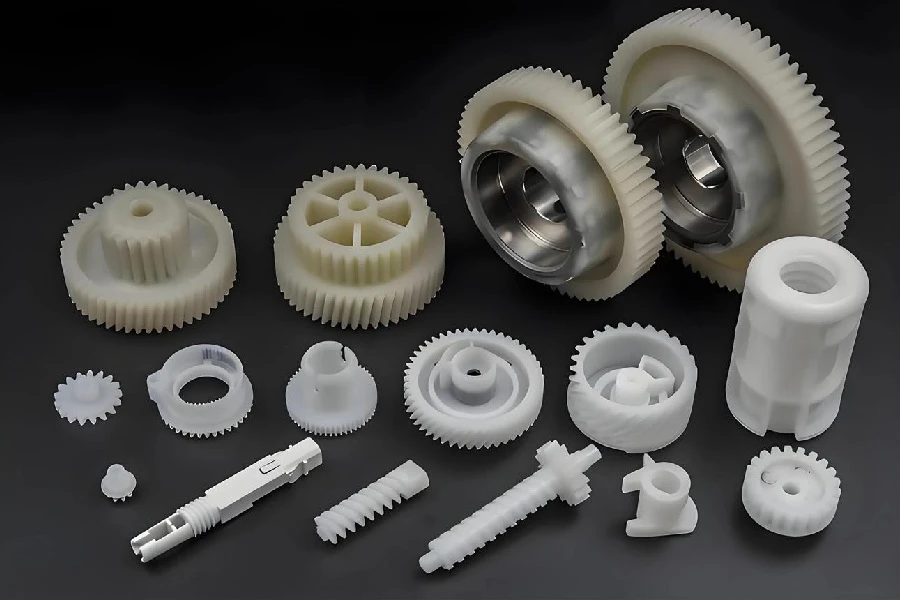
Typical products include:
- Plastic gears
- Bushings and bearings
- Rollers and wheels
- Mechanical brackets
- Cable management components
- Structural connectors
Production requirements:
- Consistent injection and holding conditions
- Dimensional stability
- Suitable material and mould design
- Repeatable production parameters
- Appropriate cooling and ejection arrangements
For components with tight dimensional requirements, machine selection should consider the injection unit's operating range, process repeatability, mould temperature control, and the characteristics of the selected resin.
The machine alone does not determine the final dimensional accuracy. Mould precision, material shrinkage, cooling conditions, and process control are equally important.
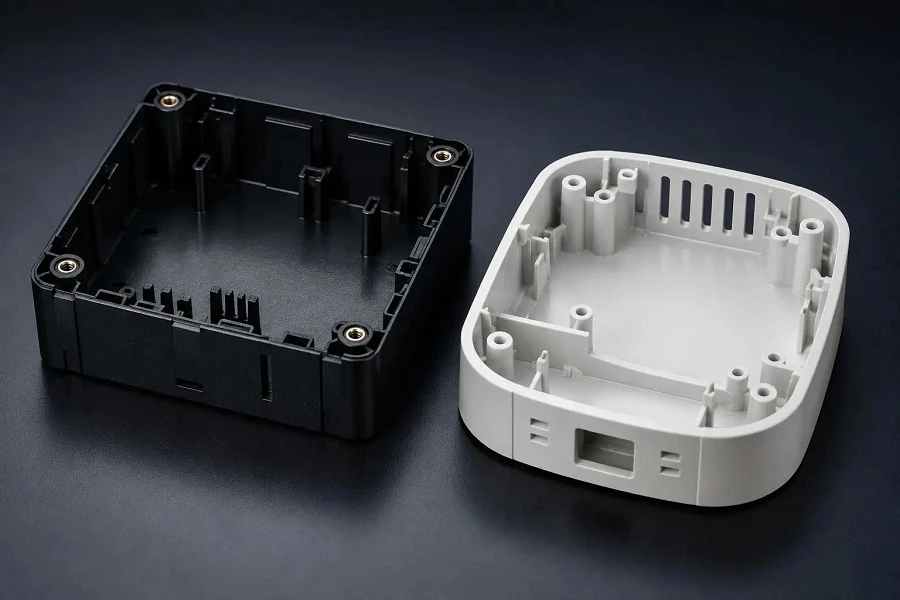
Industrial Housings, Covers and Enclosures
Plastic housings and covers protect internal components and provide structural or functional interfaces for industrial equipment.
Typical applications include:
- Equipment housings
- Machine covers
- Control box enclosures
- Power tool housings
- Protective shells
- Industrial panels and brackets
Production requirements:
- Suitable clamping force for the projected area
- Adequate platen dimensions and tie-bar spacing
- Sufficient opening stroke for deep components
- Controlled filling and holding
- Warpage management and dimensional stability
- Suitable surface appearance for functional or visible parts
Large housings may require a machine with substantial mould installation space even when the part weight is relatively low.
Machine selection should therefore consider the mould's overall dimensions, projected area, opening requirements, and injection capacity together.
Industrial Containers and Logistics Components
Industrial containers and logistics products are designed for repeated handling, stacking, storage, and transportation.
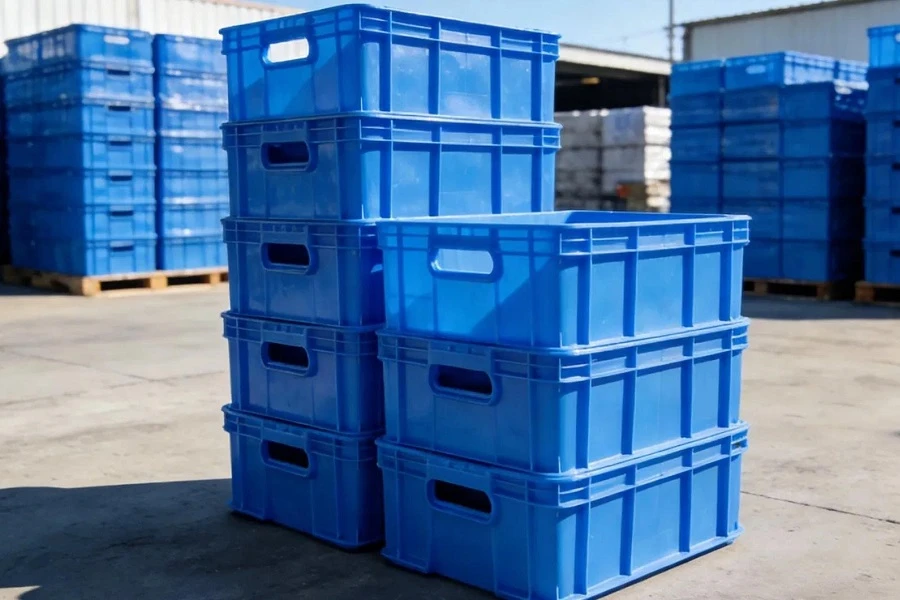
Typical applications include:
- Industrial storage bins
- Turnover boxes
- Heavy-duty crates
- Material handling containers
- Warehouse trays
- Agricultural transport containers
Production requirements:
- Sufficient clamping force for large projected areas
- Wide tie-bar spacing for large moulds
- Adequate mould opening stroke
- Suitable injection capacity
- Stable production cycles
- Robot take-out compatibility where required
Large logistics products often have extensive rib structures and relatively large projected areas. Machine selection should not be based on product weight alone.
For thin-wall or high-output container applications, injection speed and plasticising recovery may also become important. The appropriate machine type depends on the actual product geometry and cycle target.
Glass-Fibre-Reinforced Engineering Plastic Components
Reinforced engineering plastics are used in applications requiring specific mechanical or thermal properties. Common materials include PA6 GF, PA66 GF, PBT GF, PP GF, and other reinforced engineering polymers.
Typical products include:
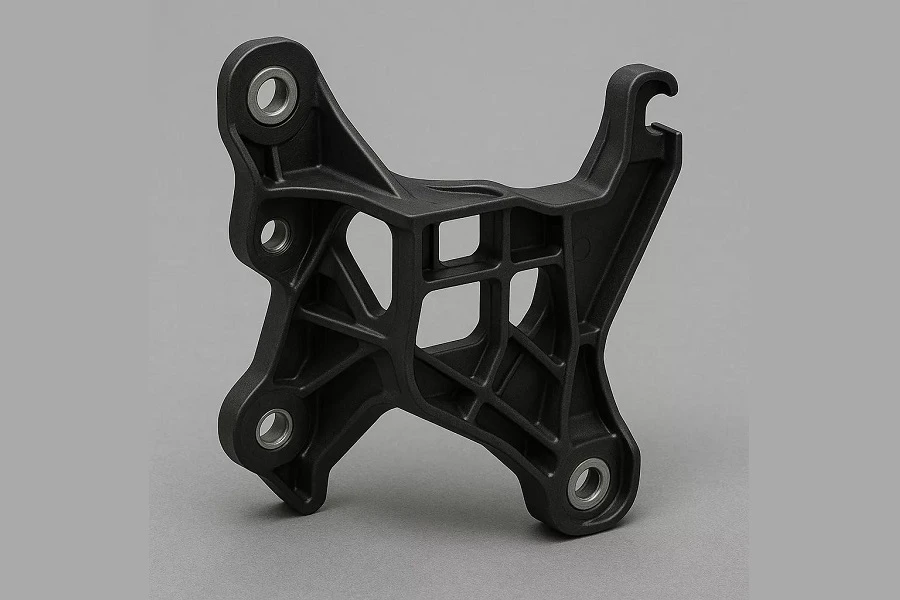
- Structural brackets
- Mechanical supports
- Reinforced housings
- Automotive and industrial connectors
- Load-bearing functional components
Production requirements:
- Material-specific screw and barrel configuration
- Suitable injection pressure and speed
- Stable plasticising performance
- Appropriate wear resistance
- Controlled material temperature
- Consistent mould filling and holding
Glass-fibre-reinforced materials can increase abrasive wear on the screw and barrel. Depending on the resin, fibre content, production volume, and expected service life, wear-resistant screw and barrel configurations may be considered.
The correct material and treatment should be selected according to the actual processing conditions rather than assuming that every reinforced resin requires the same configuration.
Fluid Handling and Industrial Functional Parts
Industrial functional components are often designed around specific operating conditions and assembly requirements.

Typical products include:
- Pump housings
- Water manifolds
- Fluid connectors
- Protective components
- Equipment mounting parts
- Industrial functional assemblies
Production requirements:
- Appropriate resin selection
- Mould structure and core-pull compatibility
- Consistent filling of functional features
- Suitable injection and holding conditions
- Dimensional consistency at assembly interfaces
For components involving internal channels, threaded features, or complex geometries, mould design and machine functions should be reviewed together before final machine selection.
2. Key Factors in Industrial Injection Moulding Machine Selection
Industrial components may have very different production requirements. A compact thick-wall fitting, a large equipment housing, and a precision gear cannot be evaluated using the same selection criteria.
Clamping Force
Clamping force should be calculated according to the total projected area of the moulded parts and runner system, together with the estimated cavity pressure.
A large component with relatively low weight may require substantial clamping force because of its projected area. Conversely, a compact thick-wall component may require a large injection shot while having a comparatively smaller projected area.
The required clamping force and injection capacity should therefore be evaluated independently.
Injection Capacity
The injection unit should be matched to the complete shot size, material, and required filling conditions, taking into account part weight, runner weight, cavity count, resin density, injection pressure and speed, and shot-size operating range.
Selecting an injection unit that is excessively large for the shot may reduce process flexibility and increase material residence time. An undersized injection unit may limit filling performance or production efficiency.
Screw Diameter and Plasticising Capacity
Screw diameter and screw design influence injection volume, injection pressure, injection rate, and plasticising performance. For industrial components, the screw and barrel should be matched to resin type, viscosity, reinforcement content, shot size, cycle time, processing temperature, and wear/corrosion requirements.
For reinforced materials, suitable wear-resistant configurations may be recommended according to the actual resin and production conditions.

Mould Dimensions and Opening Stroke
The mould must be physically compatible with the machine. Check tie-bar spacing, platen dimensions, mould height, mould weight, opening stroke, maximum daylight, and ejector stroke/force.
Deep housings, large containers, and complex industrial parts may require additional opening clearance for part removal or robot take-out.
Core Pull and Special Mould Functions

Some industrial moulds incorporate sliders, hydraulic core pulls, threaded mechanisms, or other special structures. The machine configuration should be reviewed according to required hydraulic circuits, core-pull sequence, control functions, mould protection, ejection arrangement, and automation interfaces.
Special mould functions should be confirmed during machine configuration to avoid unnecessary modifications after delivery.
3. Matching the Machine to Different Industrial Parts
Different industrial components require different machine configurations. A machine should be selected according to the limiting production requirement rather than a single specification.
| Product type | Main selection considerations |
|---|---|
| Thick-wall pipe fittings | Shot size, holding pressure, mould structure |
| Precision gears | Injection repeatability, mould precision, cooling |
| Large equipment housings | Clamping force, tie-bar spacing, platen size |
| Industrial crates | Projected area, opening stroke, injection rate |
| Glass-fibre-reinforced components | Plasticising performance, screw and barrel wear |
| Fluid handling components | Core pulls, internal structures, material compatibility |
For example:
- A large housing may be limited by mould dimensions and clamping force.
- A thick-wall fitting may be limited by injection capacity and holding requirements.
- A precision gear may require stable processing conditions and a suitable injection-unit operating range.
- A reinforced engineering component may require enhanced screw and barrel wear resistance.
4. General-Purpose vs. Specialised Injection Moulding Machines
General-Purpose Injection Moulding Machines
General-purpose machines are suitable for a broad range of industrial plastic components, offering flexibility across different moulds and materials.
Typical applications include:
- Industrial housings and covers
- Standard mechanical components
- Pipe fittings
- Functional plastic parts
- Medium-sized containers
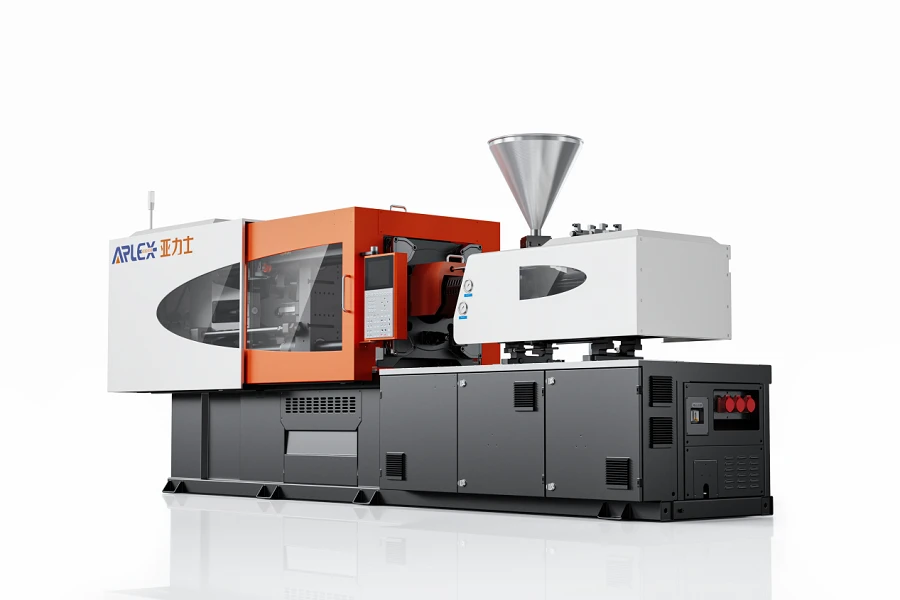
* ARLEX General-Purpose Machine
High-Speed Injection Moulding Machines
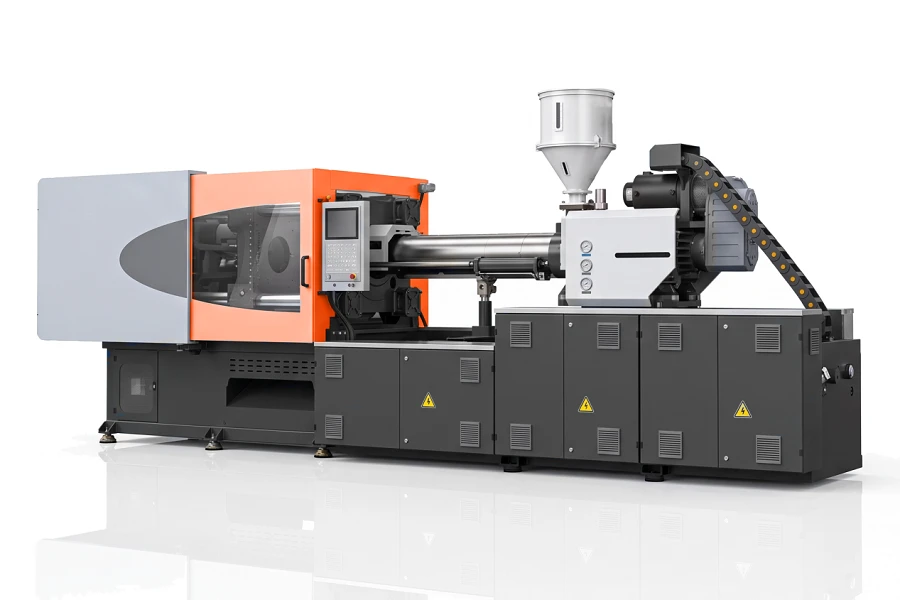
* ARLEX High-Speed Machine
High-speed machines are designed for applications requiring rapid filling and short production cycles, particularly thin-wall products.
They may be suitable for certain industrial packaging or thin-wall components when supported by product geometry, resin, mould design, and injection speed. They should not be selected simply because the product is lightweight.
PET Injection Moulding Machines
PET machines are configured for specific PET processing requirements, such as preform manufacturing. PET production requires appropriate material preparation, plasticising performance, mould configuration, and cooling arrangements.
For PET preform production, refer to our dedicated PET Preform Manufacturing Solutions page.
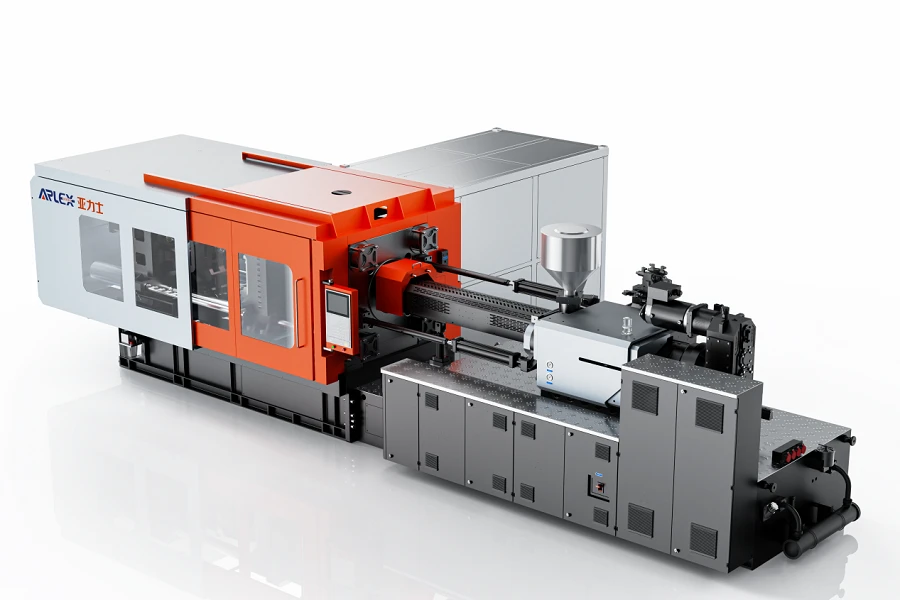
* ARLEX PET Machine
5. Common Machine Selection Mistakes
Selecting by Tonnage Alone
Clamping force does not determine the complete machine configuration. Injection capacity, mould dimensions, opening stroke, plasticising capacity, and special mould functions must also be checked.
Ignoring the Actual Resin Grade
Different grades of the same polymer may have different viscosity, processing temperatures, reinforcement content, and flow characteristics. The resin grade should be confirmed first.
Oversizing the Injection Unit
An injection unit that is excessively large for the required shot may create an unsuitable operating range. The shot size should be matched to the screw diameter and capacity.
Overlooking Mould Compatibility
A machine may have adequate clamping force but insufficient tie-bar spacing, mould-height range, opening distance, or ejector capacity. Confirm dimensions before ordering.
Ignoring Production Cycle Requirements
Target cycle time should be evaluated against injection, cooling, plasticising recovery, and part take-out. A machine may fail to achieve required cycles if recovery or automation bottlenecks occur.
6. Industrial Plastic Parts Machine Selection Process
ARLEX evaluates industrial plastic part projects through a structured machine selection process to identify actual limiting factors:
01. Product and Material
Part geometry, function, resin grade, reinforcement, and product weight.
02. Mould Structure
Mould dimensions, cavity count, projected area, core pulls, and mould weight.
03. Injection and Clamping
Shot size, injection requirements, clamping force, and machine operating range.
04. Machine Configuration
Injection unit, screw and barrel, clamping unit, and special functions.
05. Production Cell
Cycle target, robot take-out, auxiliary equipment, and factory requirements.
7. ARLEX Industrial Injection Moulding Machine Solutions
ARLEX provides injection moulding machine configurations for industrial plastic components across a wide range of product sizes, materials, and production requirements. Our approach considers the complete manufacturing process.
Depending on the project, machine configuration may include:
- Appropriate clamping force and platen dimensions
- Injection unit and screw diameter selection
- Material-specific screw and barrel configurations
- Hydraulic core-pull functions
- Mould protection and process control
- Robot take-out and automation interfaces
- Auxiliary equipment integration
For industrial projects, the objective is to identify a machine configuration that meets the actual production requirements while balancing manufacturing efficiency, operating costs, and long-term reliability.
8. What Information Should You Prepare?
To evaluate your industrial plastic part project, please provide:
Product information
- Product drawing or sample
- Product dimensions and weight
- Intended function & operating conditions
- Resin grade and reinforcement content
- Required mechanical/dimensional properties
Mould information
- Mould dimensions
- Mould weight
- Number of cavities
- Projected area
- Mould height & core-pull requirements
Production requirements
- Required output & production volume
- Target cycle time
- Existing machine specifications (if any)
- Automation requirements
- Auxiliary equipment integration
Discuss Your Industrial Plastic Parts Project
Are you manufacturing industrial housings, pipe fittings, mechanical components, reinforced plastic parts, or heavy-duty containers?
Send us your product drawings, material specifications, mould information, and production requirements. ARLEX can help evaluate the appropriate injection moulding machine configuration for your project.
Get Machine Configuration Recommendation